What enduro actually is, which capacity to start on, the kit that differs from motocross, and the real first-year budget.
Sommaire · 8 parties
01What enduro actually is
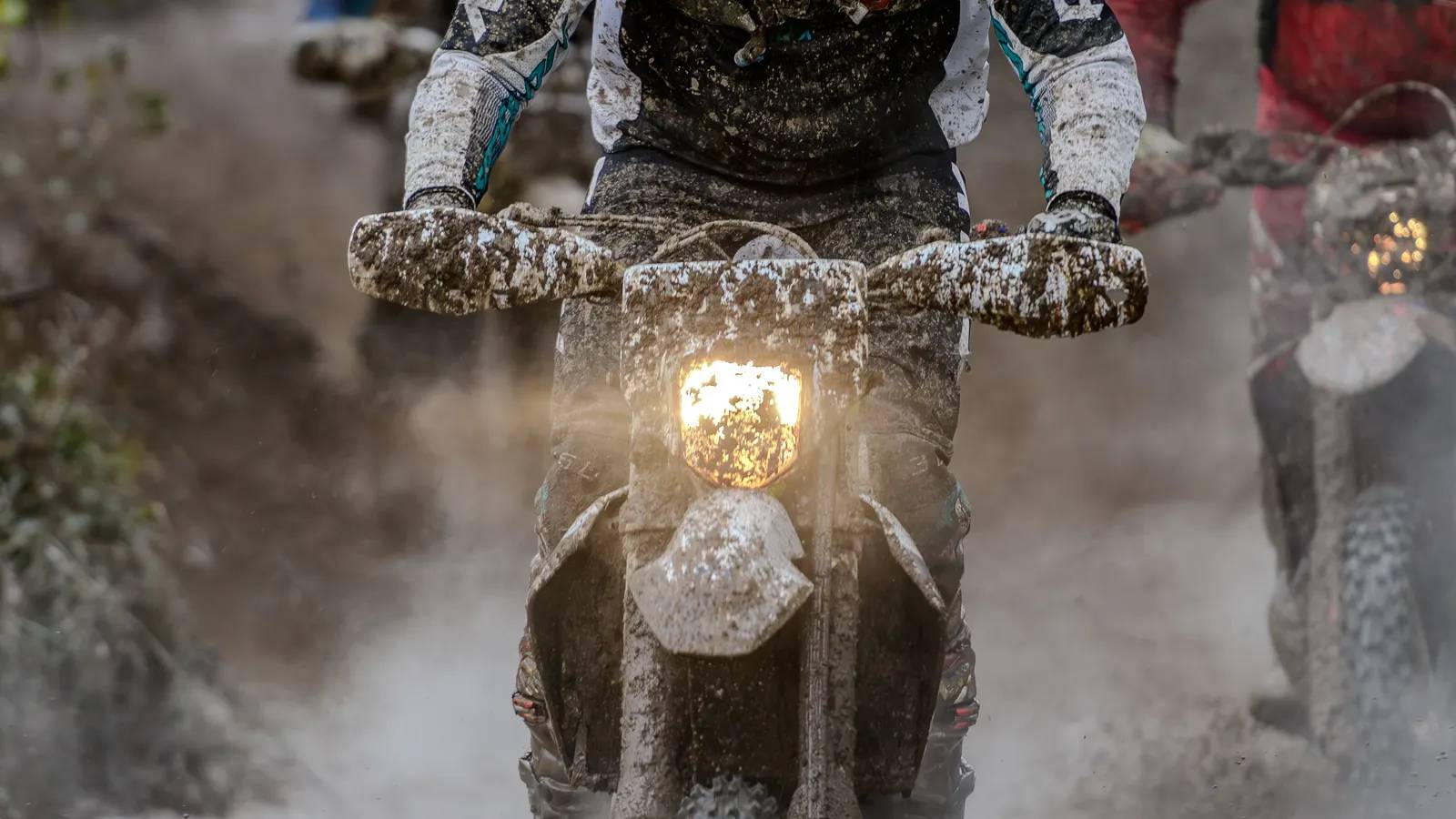
Enduro means riding off-road on tracks, trails and through forest, on a bike that is road legal: plate, lights, indicators. Unlike motocross, which happens on a closed circuit, enduro takes place in open country.
02Which bike to start on
| Capacity | Models | Who for | Used price |
|---|---|---|---|
| 125 2T | KTM 125 EXC, Yamaha YZ125X | Light, forgiving, no valves | €3,000-5,000 |
| 250 2T | KTM 250 EXC, Beta RR 250 | The enduro sweet spot | €4,000-6,000 |
| 250 4T | KTM 250 EXC-F, Honda CRF250RX | Low-down torque, easy to meter | €4,500-7,000 |
| 300 2T | KTM 300 EXC, Beta RR 300 | The enduro benchmark, very versatile | €4,500-7,000 |
Our recommendation for a beginner: a used 250 or 300 two-stroke at €4,000-5,000. Light, torque available without being violent, simple to service.
03Homologation is the point that changes everything
A road-legal enduro bike carries a plate, lights, a mirror and a horn. That is what lets you link two trails with three kilometres of tarmac, and it is the major practical difference with a motocross bike. A non-homologated machine has to be transported from one venue to the next, which means a van or a trailer for every ride.
Check the roadworthiness requirements that now apply to motorcycles, and check the insurance: riding on open roads with a machine declared for circuit use is riding uninsured.
04Gear specific to enduro
The motocross base (helmet, boots, armour) plus:
- A backpack with a hydration bladder
- Basic tools: plug spanner, tyre levers, spare tube
- Puncture kit, tubeless plugs or spare tubes
- Phone with offline GPX tracks, or a GPS tracker for ride history and anti-theft
05The first rides, in practice
Three hours is plenty the first time. Enduro tires you differently from motocross: slow balance sections, uphill restarts and obstacles work you continuously, without the recovery phases of a lap on a circuit.
Always ride with someone. A bike lying in a rut is picked up by two people in thirty seconds, and by one person in a quarter of an hour of effort, when it is possible at all.
06What to carry from the very first ride
- Water, in a hydration pack, at least two litres
- A spare tube and tyre levers
- A mini pump or CO2 cartridges
- A quick link for the chain
- A charged phone in battery saver, with the route stored offline
- Some cash and ID
07The real first-year budget
On top of the bike come full gear, licence or insurance, consumables and transport. Budget €1,500 to €2,500 in the first year on top of the machine for regular recreational riding. That is more than most people expect, and less than what a badly chosen bike costs when it has to be sold again after six months.
08Track your wear from day one
In enduro, a full day out means five to eight engine hours for barely a hundred kilometres. Since manufacturer intervals are given in hours, tracking hours avoids both traps: servicing too early and wasting money, or too late and breaking something.
Carnet d'heures scellé : trois solutions, à toi de choisir.
RUUVI 129 € (Bluetooth, compteur d'heures auto), GPS 299 € (traceur GPS anti-vol), ULTIMATE GPS 399 € (tracé GPS détaillé + anti-vol, carnet manuel). Aucun abonnement.
Comparer les trois