Why coolant matters more off-road, the real interval, waterless versus conventional, and the pressure cap nobody checks.
Sommaire · 7 parties
Coolant is the cheapest consumable on a motocross bike and the one whose neglect costs the most. A litre costs about as much as a sandwich. An engine seized by overheating costs a season.
01Why it is critical off-road
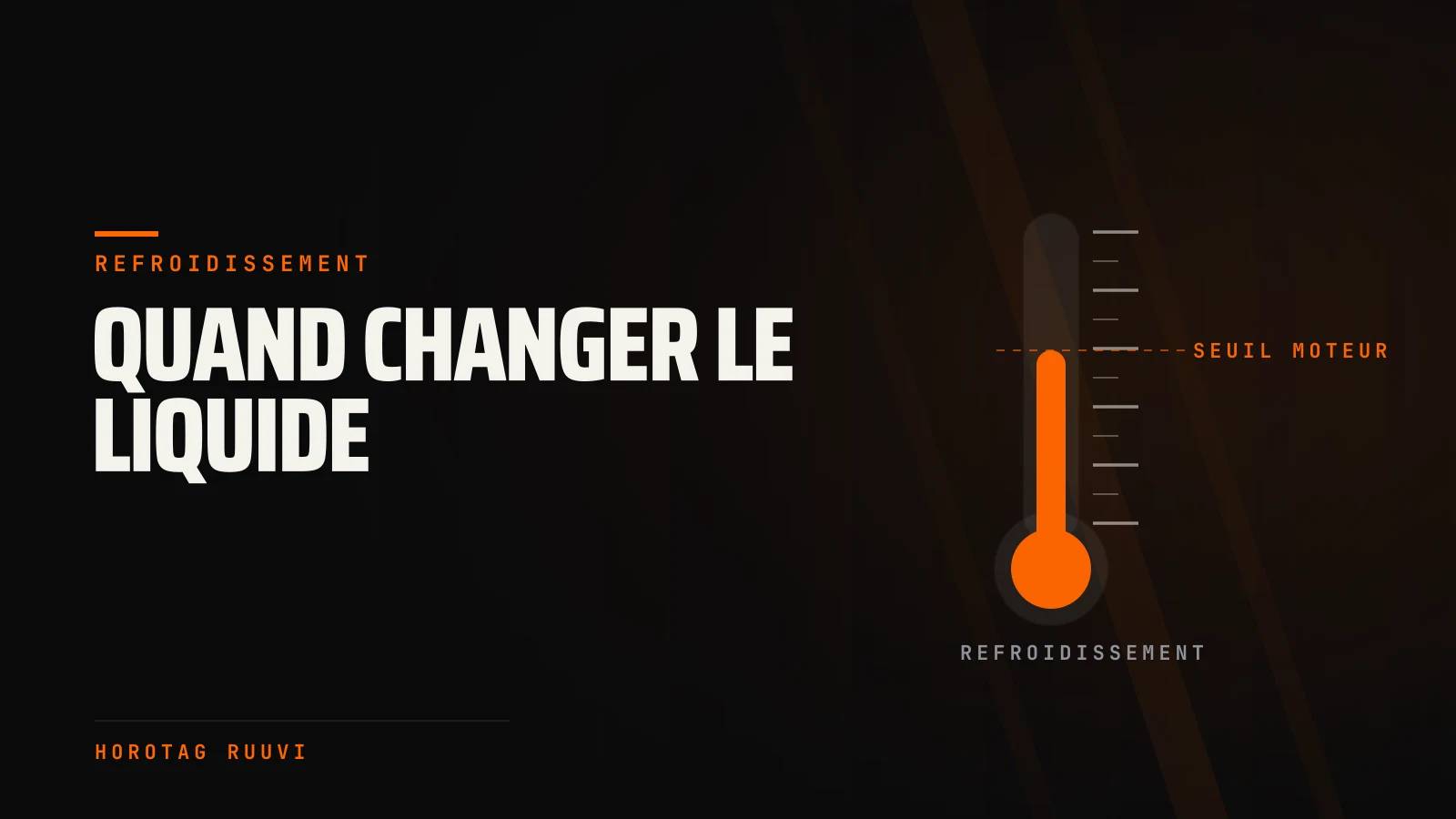
A motocross bike runs far hotter than a road bike: high revs, low speed with no airflow, slow going through woodland. The coolant degrades and loses its ability to move heat.
What actually degrades is not really the glycol, it is the anti-corrosion additives that come with it. They deplete over time and thermal cycles, and once they are gone the aluminium of the engine passages starts to pit. The deposits that follow reduce the flow section and the circuit cools less and less well, without a single part having failed.
02Interval
| Use | Coolant change | Level check |
|---|---|---|
| Motocross/enduro | Every year or 100 h | Before every ride |
| Road | Every 2 years | Monthly |
The interval is as much calendar-based as hours-based, and that is unusual. A machine that has done little riding but whose coolant is three years old needs a change: the additives age in the circuit even when it is parked.
03Which coolant
- Conventional (ethylene glycol): the standard. Motul Motocool Expert, Bel-Ray Moto Chill. €10-15 per litre.
- Waterless (Evans, Engine Ice): much higher boiling point (~180°C against ~120°C), no pressure. €25-35 per litre. Worth it for hard motocross use.
- Never plain water: corrosion, freezing in winter, boiling at 100°C.
Two points are worth knowing. Waterless coolants transfer heat less well than a conventional mix: they push the boiling point out but cool slightly more slowly in normal running, which is a good trade off in hard use and a poor one in gentle use. They also need a completely dry circuit at fill: a few percent of residual water cancels the benefit.
Never mix families either. Waterless coolant poured onto a residue of conventional mix simply becomes diluted conventional coolant, at a higher price.
04The cap does half the work
The circuit runs under pressure, around 1.1 to 1.3 bar depending on the machine, and that pressure is what pushes the boiling point well past 100°C. A cap whose spring has weakened no longer holds it: the coolant boils at normal temperature and pushes out of the overflow. It looks like a leak, you hunt for weeks, and the part responsible costs twenty euros.
Replace the cap every two to three years on an off-road bike, or as soon as a pressure test catches it out.
05Draining, step by step
1. Engine cold 2. Remove the radiator cap and the drain bolt at the bottom of the engine 3. Let it drain into a tray 4. Flush once with fresh coolant 5. Refill, run the engine for two minutes, top up 6. Bleed the air by squeezing the hoses
Step six is the one people rush. An air pocket trapped in the head creates an invisible hot spot: the gauge reads normal because the sensor sits in coolant, while part of the engine cooks dry. Bleed with the bike upright, engine running and cap off, until the level stops dropping and no more bubbles come up.
06Spotting coolant at the end of its life
- Faded, brownish or cloudy colour instead of the original green, blue or pink
- Particles or greasy deposit at the bottom of the expansion tank
- Dry white traces around the clamps, the sign of repeated weeping
- Temperature climbing faster than it used to on the same route
07What it is worth in the log
This is a ten-euro job in parts that protects a fifteen-hundred-euro bottom end. Recorded with the hours next to it, it tells a future buyer the machine was looked after by someone who knew what they were doing. Unrecorded, it never happened.
Un compteur d'heures fiable + un carnet automatique, c'est ce que fait HOROTAG RUUVI.
Boîtier sous la selle, app gratuite, sans abonnement. 129 € payés une fois.
Voir HOROTAG RUUVI