Why off-road radiators fail, how to spot overheating early, straightening fins, the pressure test and what a replacement costs.
Sommaire · 7 parties
A motocross radiator almost never dies of old age. It dies of a stone, a neighbour handlebar or a slow tip-over, and it dies fast: between the first leak and a seized engine there is sometimes less than five minutes of riding.
01Why off-road radiators fail
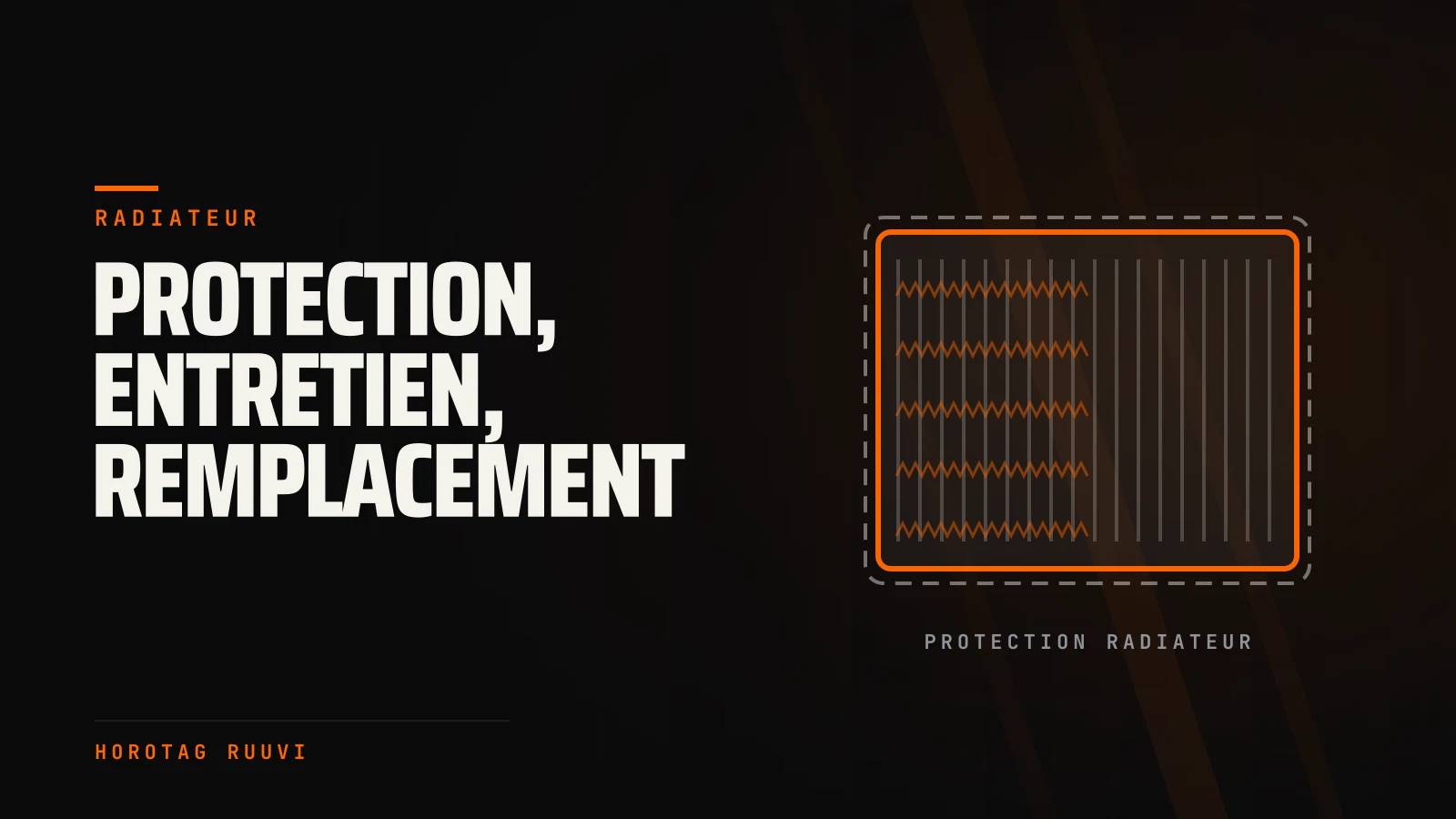
Flying stones, contact with other riders and crashes wreck the fins. A holed radiator means overheating, and prolonged overheating means a seized engine.
Three causes come up again and again. Stone strikes first: a rock thrown by the rider ahead arrives at speed against an aluminium wall a few tenths of a millimetre thick. Crashes next, including slow ones: the radiator is the first thing to touch the ground when the bike goes over, because handguards and bars do not cover its full height. Clogging last, and it is the sneakiest: dried mud between the fins divides the exchange surface without a single part being broken.
02Spotting overheating early
Before it fails, the bike warns you. Coolant pushing out of the overflow after you stop is the clearest signal. A sweet smell when hot, dry white or green traces down the radiator, a fan running constantly on a machine fitted with one: they all say the same thing.
The cooling circuit runs under pressure by design. The cap holds around 1.1 to 1.3 bar, which pushes the boiling point well past 100°C. A tired cap no longer holds it: coolant boils at normal temperature, pushes out of the overflow, and the level drops ride after ride with no hose leaking anywhere. It is the most common failure and the cheapest to fix.
03Guards
| Type | Price | Effectiveness |
|---|---|---|
| Aluminium guards (Devol, Unabiker) | €80-150 a pair | Excellent |
| OEM plastic guards | €30-60 | Moderate, fragile |
| Aluminium tape | €5 | Trailside repair only |
Aluminium guards fit in twenty minutes and move from bike to bike as long as the mounts match. Their only drawback is a slight reduction in airflow, which only shows in very slow enduro riding when forward speed no longer ventilates.
Radiator braces, the bars linking the two sides, do a different and complementary job: they stop the radiator twisting in a crash, the movement that splits header seams without leaving a visible mark.
04Care
- Gentle water on the fins after every ride
- Check the coolant level
- Inspect the hoses for cracking
- Pressure test with a cap tester (15-20 psi)
Gentle is the important word. A pressure washer at close range lays the fins flat in a second, and a flattened fin dissipates nothing. Wash with clean water, from a distance, from the inside out so the dirt leaves the way it came in.
Fins that are already flattened can be straightened with a fin comb or, failing that, the tip of a very thin flat screwdriver, one fin at a time, without forcing. It is slow work, but half an hour with a comb often returns more cooling than an aftermarket radiator.
05The pressure test, in practice
1. Engine cold, open the cap and check the level 2. Fit the tester in place of the cap 3. Pump to the pressure marked on the original cap 4. Wait ten minutes without touching anything 5. If the needle drops there is a leak: look for damp traces on headers, seams and clamps
A circuit that holds for ten minutes will hold for a ride. A circuit losing a tenth of a bar in ten minutes will lose its coolant on the first long climb.
06When to replace
- Unrepairable leak, a hole in the core
- Fins crushed over more than 30% of the surface
- A cap that no longer holds pressure
New OEM radiator: €200-400. Aftermarket (Mishimoto, Twin Air): €150-300.
Epoxy and solder repairs last a moto, not a season. They belong in the back of a van to finish a day, never as a permanent fix: the repaired area becomes a hard spot that splits again at the first thermal shock.
07What it changes in the log
Overheating leaves no trace on an hour meter, but it leaves a trace in the engine. A radiator replaced, a circuit bled, a cap changed: these are the lines that explain, two hundred hours later, why this engine survived and the one next to it seized.
Un compteur d'heures fiable + un carnet automatique, c'est ce que fait HOROTAG RUUVI.
Boîtier sous la selle, app gratuite, sans abonnement. 129 € payés une fois.
Voir HOROTAG RUUVI