How many hours between front and rear brake pad changes on motocross and enduro bikes, and how to spot wear before the pads let go.
Sommaire · 6 parties
Brake pads are the consumable that destroys the most discs when you let them run on. Here is how to manage the interval properly.
01Average hours
For intensive motocross use:
- 2-stroke 50/65/85: front ~15-20 h, rear ~15-20 h.
- 2-stroke 125: front ~20-25 h, rear ~20-25 h.
- 2-stroke 250/300: front ~25-30 h, rear ~25-30 h.
- 4-stroke 250: front ~25-30 h, rear ~30-35 h.
- 4-stroke 350: front ~30-35 h, rear ~30-35 h.
- 4-stroke 450: front ~25-30 h, rear ~25-30 h.
- 4-stroke 500+ enduro: front ~35-45 h, rear ~35-45 h.
The rear often lasts a bit longer in motocross (the front does most of the work). In enduro, the front can last longer if you brake mostly with your right foot.
02Variables that change everything
- Riding style: a rider who brakes late and hard wears pads twice as fast as someone out for a relaxed ride.
- Terrain: abrasive mud and sand (silica) chew through pads. On sand, halve the intervals.
- Pad brand: organic (Galfer, EBC standard) versus sintered metallic (SBS Sinter, Brembo Z03): sintered pads last 30 to 50 % longer but are harder on the disc.
03How to check wear
Every time you wash the bike:
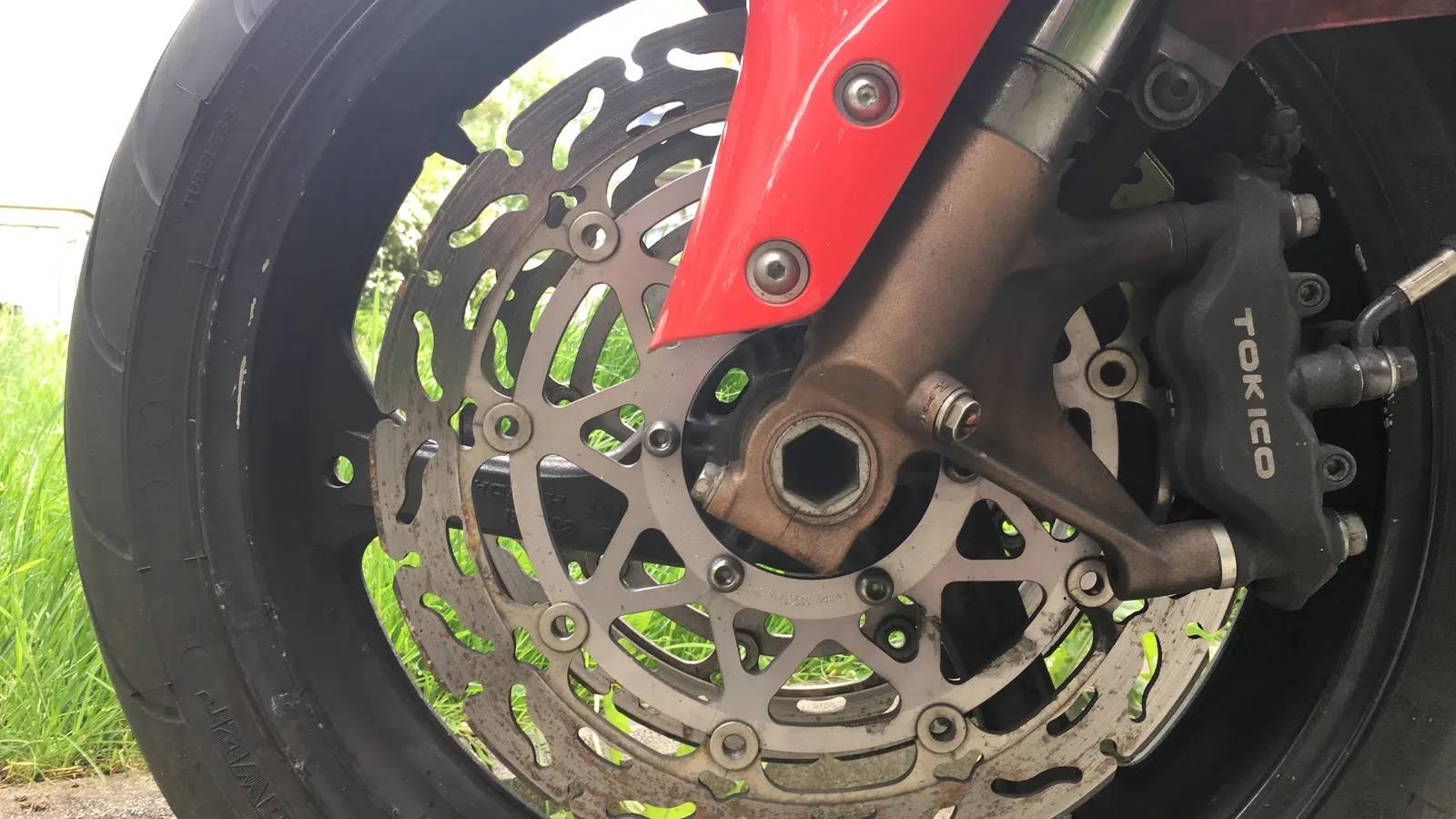
1. Shine a torch on the front caliper. 2. Look at the remaining friction material: you can see the pad between the metal backing plate and the disc. 3. If less than 1.5 mm is left: change them before the next ride. 4. If you can see the metal backing plate touching the disc: you have left it too late, and the disc probably needs replacing too.
04Symptoms that never lie
- A shrill metallic noise under braking = friction material gone, the backing plate is scraping the disc.
- A brake lever that goes soft or has to travel further before it bites.
- A master cylinder that "swells" under sustained braking (temperature too high, pads finished).
05Do not forget the brake fluid
While you have the pads out, look at the colour of the fluid:
- Light gold: fine, redo it at 1 year.
- Dark brown: bleed it now.
DOT 4 absorbs moisture over time. At 3 % moisture content, the boiling point drops from 270 °C to 155 °C: you can end up with your brakes fading away at the bottom of a descent.
06How to stop forgetting
The engine hour meter gives you the right reference point: at exactly 25 h since the last change, the app tells you "check brake pads". You open the caliper, you look, you decide. No more "hmm, I think I changed them before last winter".
Carnet d'heures scellé : trois solutions, à toi de choisir.
RUUVI 129 € (Bluetooth, compteur d'heures auto), GPS 299 € (traceur GPS anti-vol), ULTIMATE GPS 399 € (tracé GPS détaillé + anti-vol, carnet manuel). Aucun abonnement.
Comparer les trois